


An exhibitor list is more than a directory of companies attending a trade show. When the data is cleaned, segmented, enriched and connected to a clear sales strategy, it can become a practical source of B2B prospects.
The most effective approach is not to contact every exhibitor. Instead, define the type of company you want to reach, identify the exhibitors that match your ideal customer profile, research their business needs, and build a personalized follow-up process.
Direct answer: To use an exhibitor list for B2B prospecting, first define your ideal customer profile, collect and clean the exhibitor data, segment companies by business type, score each account, verify public contact information, personalize your outreach and track every follow-up in a CRM.
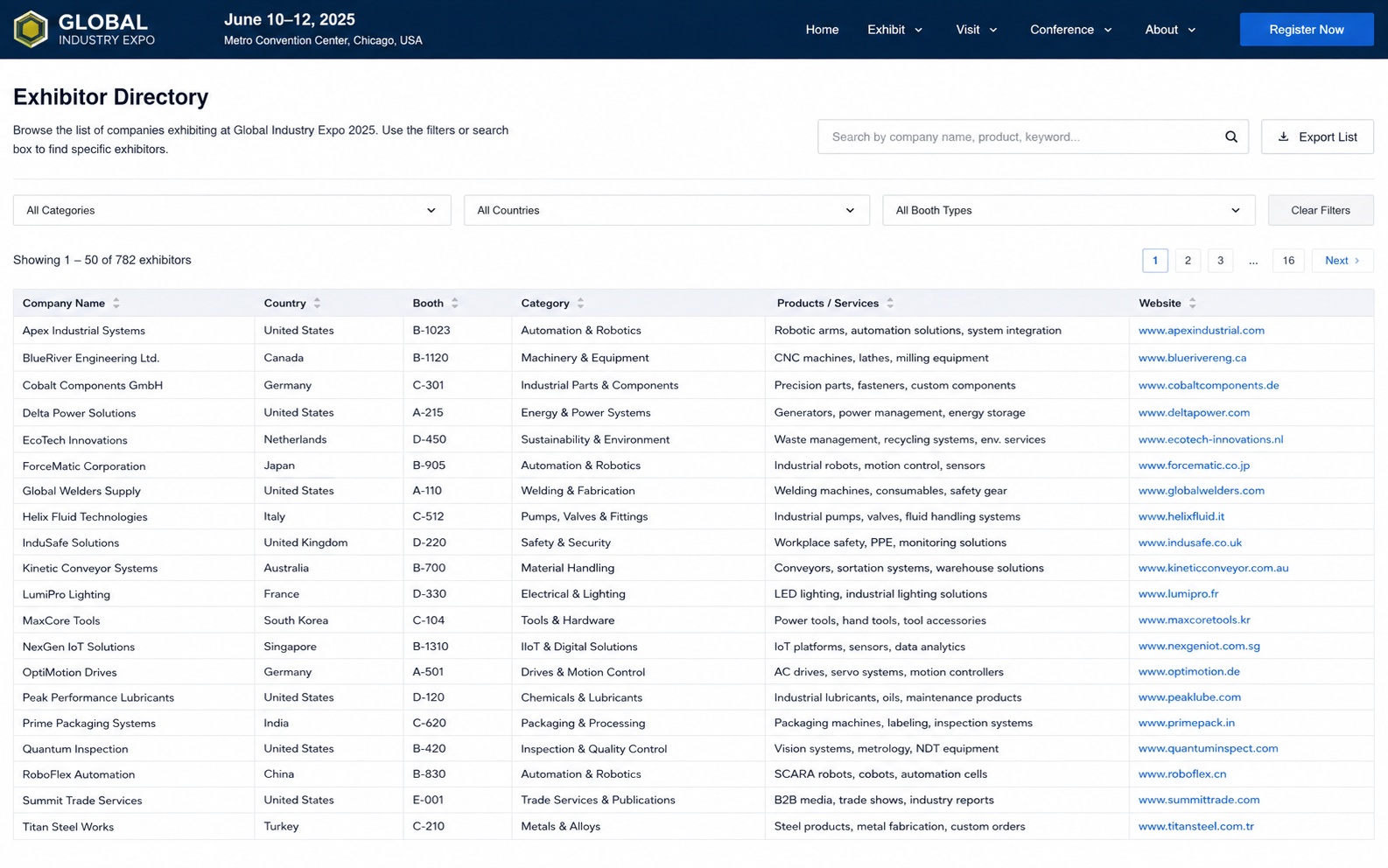
What Is an Exhibitor List?
An exhibitor list is a directory of companies that have registered to exhibit at a trade show, business expo or industry conference.
Depending on the event, an exhibitor directory may contain:
- Company name
- Booth or stand number
- Exhibition hall
- Country or region
- Product category
- Company description
- Official exhibitor profile
- Company website
- Public contact information
Some event directories are highly detailed, while others provide little more than a company name and booth number.
An exhibitor list should not be confused with an attendee list.
An exhibitor list identifies companies that have booked exhibition space or an official event presence. An attendee list usually contains information about individual visitors, buyers or delegates and is often private or restricted to the official event platform.
For B2B prospecting, exhibitors are valuable because they have already revealed several useful business signals:
- The company is active in a particular industry.
- It is investing time and money in market visibility.
- It may be launching products or entering a new region.
- It may be looking for buyers, distributors, suppliers or partners.
- Its current product focus can often be identified from the event category.
However, the raw directory is only the starting point. It still needs to be converted into a structured and qualified prospecting list.
Why Exhibitor Lists Are Useful for B2B Prospecting
Traditional lead generation often begins with broad company searches, generic directories or purchased business lists. These sources may contain many companies that are technically in the right industry but have no current reason to engage.
An exhibitor directory provides additional context.
The company has selected a specific event, market and product category. This can create a more relevant starting point for sales research.
Industry Relevance
A specialist trade show naturally groups companies around a defined market.
For example, exhibitors at a fire safety exhibition may include:
- Fire detection manufacturers
- Gas detection companies
- Alarm system suppliers
- Fire suppression companies
- PPE manufacturers
- Rescue equipment suppliers
- Distributors and system integrators
This is more focused than searching for general industrial companies.
Current Market Activity
Exhibiting can indicate that a company is actively promoting products, expanding its network or developing new business.
It does not automatically mean that the company needs your product. However, it provides a stronger reason for research than a random company record.
Better Outreach Context
The exhibition gives you a natural reason to start a conversation.
Instead of sending a completely cold message, you can connect your outreach to:
- The company’s exhibited product
- Its event category
- Its target application
- Its regional expansion
- A possible sourcing requirement
- A potential distribution partnership
- A technical integration opportunity
Easier Market Segmentation
Exhibitor profiles often contain enough information to separate companies into meaningful groups, such as:
- Potential buyers
- Distributors
- Manufacturers
- Suppliers
- System integrators
- Service providers
- Technology partners
- Competitors
- Research-only accounts
This segmentation is essential because each company type requires a different message.
The Seven-Step Exhibitor List Prospecting Workflow
A practical exhibitor list prospecting process can be organized into seven steps.
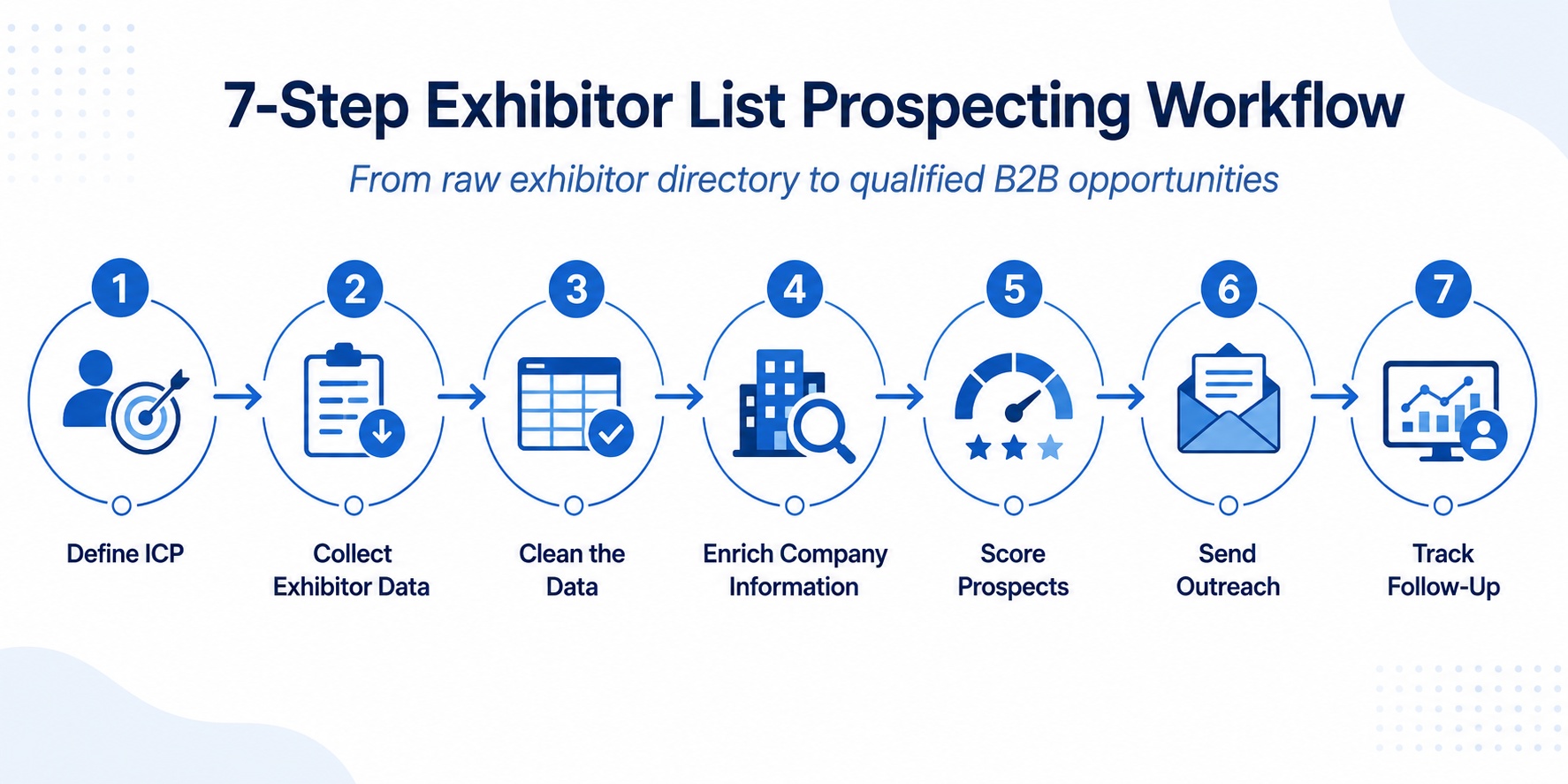
- Define your ideal customer profile.
- Collect the exhibitor data.
- Clean and structure the records.
- Enrich the company information.
- Score and prioritize prospects.
- Send relevant outreach.
- Track follow-up and sales progress.
The objective is to reduce a large directory into a smaller list of companies that deserve genuine sales attention.
Step 1: Define Your Prospecting Goal
Before collecting data, determine what you are trying to achieve.
Different prospecting goals require different qualification criteria.
| Prospecting Goal | Companies to Prioritize | Possible Outreach Angle |
|---|---|---|
| Find buyers | Brands, manufacturers, integrators and end users | Product supply, technical integration or cost reduction |
| Recruit distributors | Importers, wholesalers and regional sales companies | Distribution rights, portfolio expansion or local market cooperation |
| Source suppliers | Manufacturers, component producers and service providers | Sourcing requirements, quotation requests or supplier qualification |
| Build partnerships | Complementary technology and solution companies | Integration, co-development or joint market development |
| Map competitors | Similar manufacturers and emerging brands | Market research rather than immediate outreach |
| Find OEM customers | Product brands and equipment manufacturers | Customization, private labeling or embedded product integration |
Write your goal as one sentence:
We want to identify [company type] in [target region or industry] that may need
.
For example:
We want to identify European fire safety distributors that may need gas detection sensors or OEM sensor modules.
This statement becomes the basis for filtering and scoring every exhibitor.
Step 2: Turn the Raw Directory into Structured Data
Raw exhibitor pages are rarely ready for sales use.
Information may be spread across:
- Event list pages
- Individual exhibitor profiles
- Company websites
- Product pages
- Contact pages
- PDF show guides
- Event maps
- Social or business profiles
The first practical task is to place the data into consistent fields.
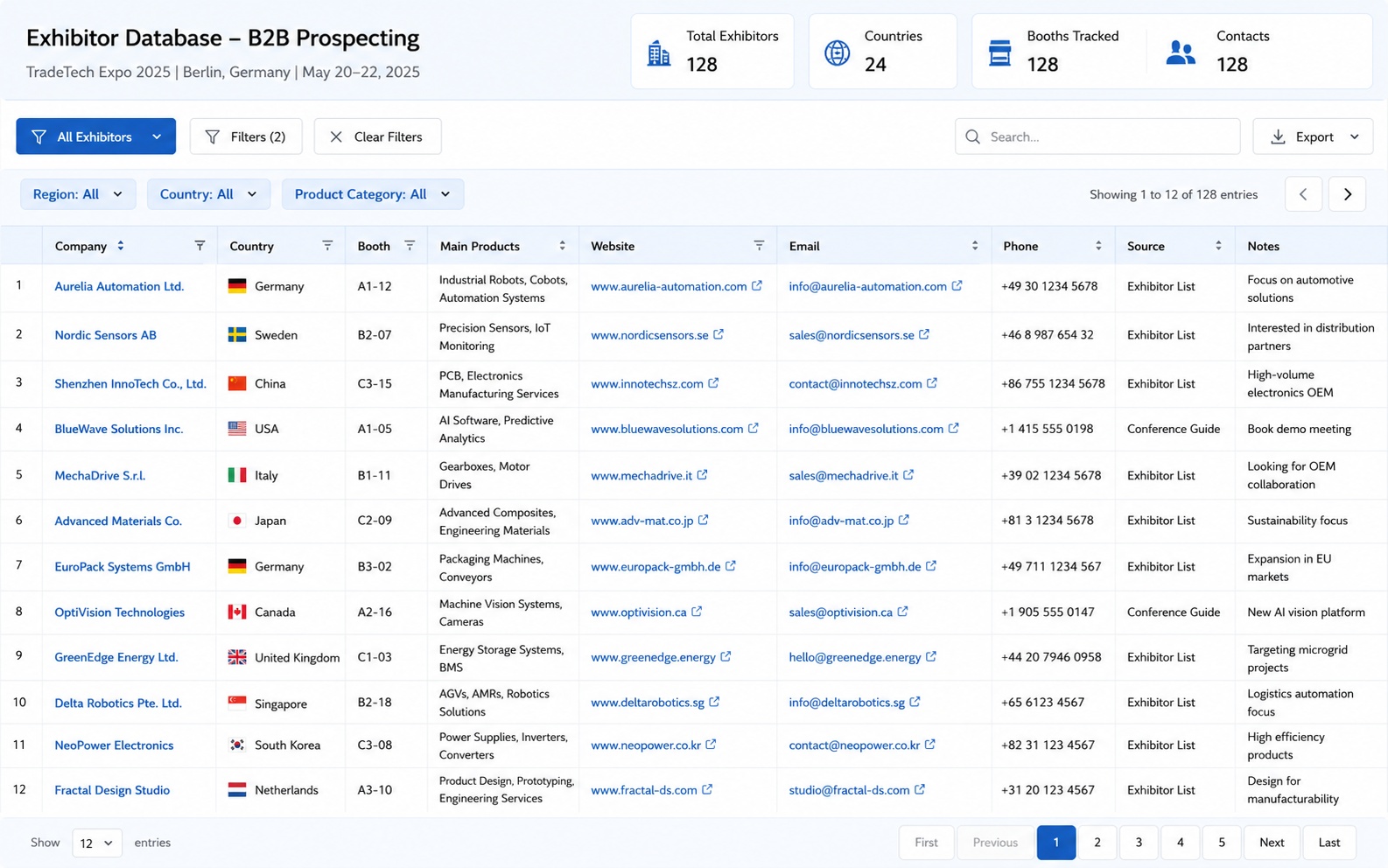
A useful exhibitor database may include the following columns:
| Field | Prospecting Value |
|---|---|
| Company Name | Creates the main account record |
| Country | Supports territory and language filtering |
| Booth or Stand | Confirms event participation and supports meeting planning |
| Official Exhibitor URL | Preserves the original event source |
| Company Website | Provides the primary research source |
| Main Products | Helps determine product and application relevance |
| Public Email | Provides a possible business contact channel |
| Public Phone | Supports verification and direct communication |
| Address | Helps identify office location and market coverage |
| Lead Segment | Identifies buyers, suppliers, distributors or competitors |
| Source URL | Shows where contact information was found |
| Confidence Level | Indicates how reliable the information appears |
| Notes | Records opportunities, risks and research findings |
Clean the Company Names
Company names may appear in multiple formats.
For example:
- ABC Sensor
- ABC Sensor Ltd.
- ABC Sensor Technology Co., Ltd.
- ABC Sensor Europe GmbH
Some may be separate regional entities, while others may be duplicates.
Do not automatically merge them without checking the company website and legal information.
Standardize Countries and Regions
Use consistent country names throughout the file.
Avoid mixing formats such as:
- USA
- U.S.
- United States
- United States of America
A standardized country field makes filtering and CRM import much easier.
Normalize Websites and Phone Numbers
Remove unnecessary tracking parameters from website URLs and place phone numbers in a consistent format where possible.
Keep the original country code.
Remove Shared Organizer Information
Some exhibitor pages display the same organizer email, event hotline or footer contact on every company profile.
This information should not be treated as the exhibitor’s own contact data.
Keep Unknown Fields Blank
Do not invent or guess missing emails, phone numbers, contact people or company details.
A blank but honest field is more useful than incorrect information.
Step 3: Segment Exhibitors by Business Type
Segmentation determines how each company should be evaluated and contacted.
A basic segmentation model may include:
Potential Buyer
A company that may directly purchase your product or service.
Examples include:
- Equipment manufacturers
- Product brands
- System integrators
- Engineering companies
- Industrial end users
Distributor or Importer
A company that sells multiple brands or supplies products within a specific country or region.
Useful indicators include:
- Distributor language on the website
- Multiple represented brands
- Local warehouses
- Dealer networks
- Regional sales coverage
- Import and export activity
Manufacturer or Supplier
A company that produces components, equipment or supporting products.
This segment may be relevant for:
- Supplier discovery
- Contract manufacturing
- Component sourcing
- OEM cooperation
- Technology integration
Service Provider
This category may include:
- Testing laboratories
- Certification companies
- Consultants
- Logistics providers
- Marketing companies
- Event service companies
Some service providers may be useful partners, but they should not be scored in the same way as direct buyers.
Competitor
Competitors can still be valuable for market research.
Their exhibition presence may help you study:
- Product positioning
- Target applications
- Regional activity
- New product launches
- Distribution strategy
- Event participation patterns
Competitor records should normally be separated from sales outreach lists.
Step 4: Build an Exhibitor Lead Scoring Model
A lead scoring model helps sales teams decide which companies deserve manual research and personalized contact.
The scoring system should reflect your actual business priorities.
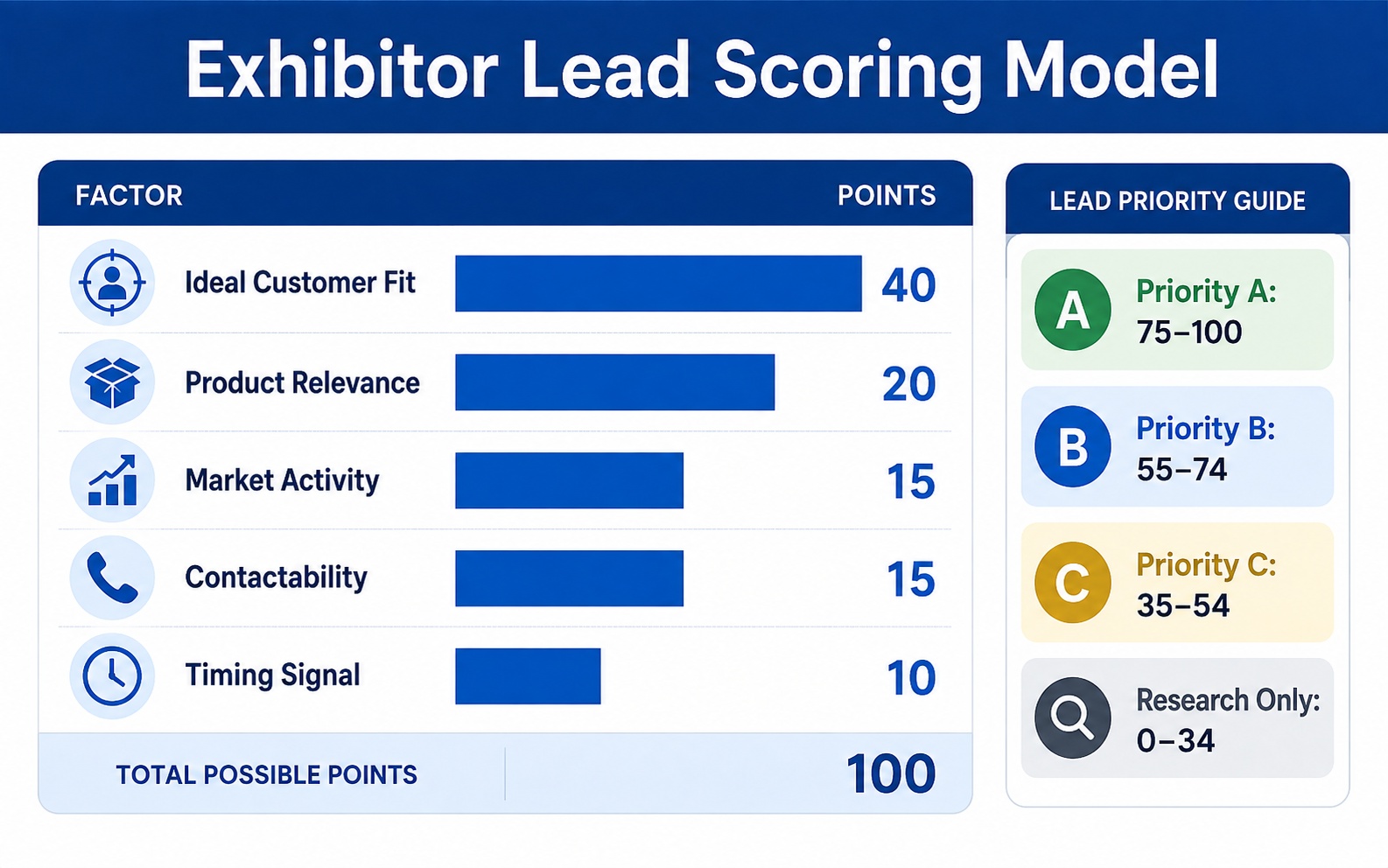
The following 100-point structure can be used as a starting point:
| Scoring Factor | Maximum Points | Evaluation Question |
|---|---|---|
| Ideal Customer Fit | 40 | Is this the right company type, market, industry and region? |
| Product Relevance | 20 | Does the company sell, use or integrate products related to your offer? |
| Market Activity | 15 | Is the company actively exhibiting, expanding or launching products? |
| Contactability | 15 | Can a relevant public business contact or department be identified? |
| Timing Signal | 10 | Does the exhibition create a meaningful reason to start a conversation? |
| Total | 100 |
Suggested Priority Levels
| Score | Priority | Recommended Action |
|---|---|---|
| 75–100 | Priority A | Manual research and highly personalized outreach |
| 55–74 | Priority B | Relevant outreach with moderate personalization |
| 35–54 | Priority C | Further qualification before contacting |
| 0–34 | Research Only | Keep for market research or exclude |
A high score does not guarantee that the company will become a customer. It simply indicates that the account appears more relevant based on the available information.
Step 5: Research Priority Accounts
After scoring, research the highest-priority companies individually.
The purpose is to answer two questions:
- Why is this company relevant?
- What specific reason do we have to contact it?
Review the Official Exhibitor Profile
Look for:
- Product categories
- Exhibited products
- Booth location
- Company description
- Event-specific announcements
- New product information
- Target applications
Review the Company Website
Study the following pages:
- About Us
- Products
- Applications
- Industries
- Distributors
- News
- Contact
- Careers
- Certifications
A company website can help determine whether the exhibitor is a manufacturer, distributor, integrator or end user.
Identify a Relevant Commercial Opportunity
Useful opportunity signals may include:
- A gap in the company’s current product range
- A need for OEM components
- Expansion into a new application
- Regional distributor recruitment
- Existing products that could integrate your technology
- A new product launch
- A sourcing or manufacturing requirement
- A complementary technical capability
Record the finding in one short sentence.
For example:
The company distributes industrial monitoring products in Germany but does not currently show a complete gas sensor module range.
This note is far more useful than a generic label such as “potential customer.”
Step 6: Personalize the Outreach
The exhibition should provide context for your message, but simply saying that you found the company on an exhibitor list is not enough.
A relevant message should explain:
- Why you selected this company
- What you noticed about its products or market
- How your offering may be relevant
- What next step you are proposing
Example Pre-Show Outreach
Subject: Potential cooperation around

Hello [Name or Team],
I was reviewing companies exhibiting in the [category] section of [event name] and noticed that [Company] focuses on [specific product, application or market].
We supply [relevant product or service] for companies working with [specific application]. Based on your current product range, there may be a potential fit around [specific cooperation point].
Would it be useful if I sent a short product overview or discussed your current sourcing requirements before the event?
Best regards,
[Name]
[Company]
[Website]
Example Distributor Outreach
Subject: Distribution cooperation for
Hello [Name or Team],
I noticed that [Company] supplies [related products] in [country or region] and is exhibiting at [event name].
We manufacture for [main applications] and are currently evaluating potential distribution cooperation in your market.
Your existing focus on [specific industry or product line] appears relevant. May I send you a short overview of our product range and distributor support?
Best regards,
[Name]
[Company]
[Website]
Example Supplier or Sourcing Outreach
Subject: Sourcing inquiry for [component or product]
Hello [Name or Team],
We found [Company] while researching exhibitors in the [category] section of [event name].
We are currently evaluating suppliers for [specific component, service or manufacturing capability]. Your work in [relevant area] appears connected to our requirement.
Could you share your available specifications, minimum order quantity and export capabilities?
Best regards,
[Name]
[Company]
[Website]
Keep the First Message Focused
The first email should not contain your full company history, complete catalog and every possible cooperation idea.
Focus on:
- One reason for contacting the company
- One relevant capability
- One clear next step
Step 7: Plan Outreach Around the Event Timeline
Trade show prospecting works better as a sequence than as a single email.
| Timing | Recommended Activity |
|---|---|
| 6–8 weeks before | Collect the exhibitor directory and define target segments |
| 4–6 weeks before | Clean, enrich and score the exhibitor records |
| 3–4 weeks before | Research Priority A accounts |
| 2–3 weeks before | Begin personalized outreach |
| 1 week before | Confirm meetings and prepare account questions |
| During the event | Record conversations, observations and next steps |
| 2–5 business days after | Send event-specific follow-up |
| 2–4 weeks after | Continue qualified opportunities and update CRM stages |
Avoid sending the first message immediately before the exhibition. Many exhibitors are already busy with travel, booth preparation and logistics.
At the same time, contacting companies too early may reduce the relevance of the event.
The best timing depends on:
- The size of the event
- The complexity of your product
- The length of your sales cycle
- Whether you plan to attend in person
- The importance of the target account
How to Track Exhibitor Leads in a CRM
A spreadsheet can organize exhibitor data, but a CRM is better for tracking communication and sales progress.
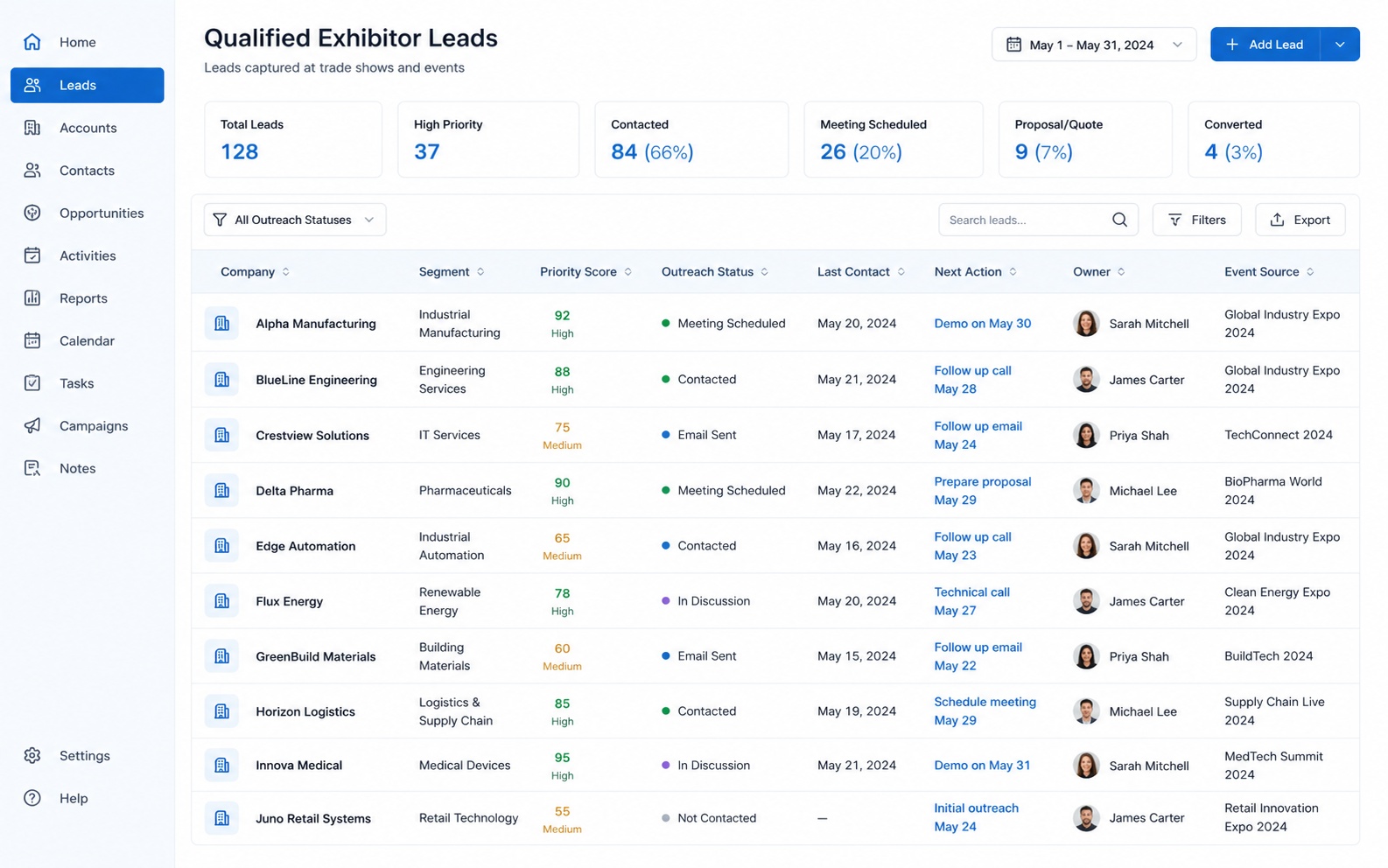
Before importing an exhibitor CSV, define the CRM fields clearly.
| CRM Field | Example |
|---|---|
| Lead Source | Exhibitor List |
| Event Name | Industry Expo 2026 |
| Company Segment | Distributor |
| Priority Score | 82 |
| Priority Level | A |
| Reason for Fit | Regional distributor of industrial safety products |
| Contact Status | Researched |
| Outreach Status | Email Sent |
| Last Contact Date | August 12, 2026 |
| Next Action | Follow-up email |
| Next Action Date | August 18, 2026 |
| Account Owner | Regional Sales Manager |
| Data Source | Official exhibitor profile and company website |
Recommended Lead Stages
Use simple and consistent lead stages:
- Collected
- Cleaning Required
- Researched
- Qualified
- Contacted
- Replied
- Meeting Scheduled
- Opportunity Created
- Proposal Sent
- Closed Won
- Closed Lost
- Research Only
Metrics Worth Tracking
Do not measure success only by the number of emails sent.
Track the full process:
- Total exhibitors collected
- Relevant companies identified
- Priority A accounts
- Priority B accounts
- Companies researched
- Companies contacted
- Positive replies
- Meetings scheduled
- Qualified opportunities
- Proposals sent
- Deals won
- Revenue connected to the event
The most useful metric is the percentage of raw exhibitor records that become qualified business opportunities.
Practical Example: From 500 Exhibitors to 15 Priority Accounts
Consider an industrial sensor manufacturer using an automation exhibition for prospecting.
The event directory contains 500 exhibitors.
Initial Filtering
The sales team filters for companies related to:
- Industrial sensors
- Gas detection
- Environmental monitoring
- Automation systems
- IoT devices
- Safety equipment
- System integration
- Industrial distributors
This reduces the list from 500 to 160 potentially relevant companies.
Business-Type Segmentation
The 160 companies are separated into:
- 45 potential buyers
- 35 distributors
- 30 manufacturers
- 20 system integrators
- 15 service providers
- 15 competitors or research-only accounts
Lead Scoring
After applying the scoring model:
- 15 companies receive Priority A status.
- 30 companies receive Priority B status.
- 55 companies require additional qualification.
- The remaining companies stay in the research database.
Account Research
The sales team manually researches the 15 Priority A companies and records:
- Current product range
- Main applications
- Regional market
- Possible product gap
- Public contact channel
- Recommended outreach angle
The original directory of 500 companies has now become a focused list of 15 accounts suitable for personalized outreach.
This is the real value of an exhibitor list for B2B prospecting: not more contacts, but better-qualified companies.
Common Exhibitor List Prospecting Mistakes
Contacting Every Exhibitor
A large directory may contain competitors, event service companies, media organizations and unrelated suppliers.
Sending the same message to everyone reduces relevance and may harm your email reputation.
Treating Every Company as a Buyer
Some exhibitors are distributors, suppliers, laboratories, consultants or competitors.
The company type should be identified before outreach.
Using Unverified Contact Information
Company websites, emails and phone numbers can change.
Verify important contacts before sending high-value proposals or starting long outreach sequences.
Copying the Same Message
Event-based personalization should go beyond inserting the exhibition name.
A useful message should refer to the company’s actual products, application or market.
Ignoring the Original Source
Keep the official exhibitor URL and the source of any public contact information.
Source records make future verification easier.
Failing to Record the Next Action
A qualified prospect without a follow-up date can easily be forgotten.
Every active account should have:
- An owner
- A current status
- A next action
- A next action date
Using Data Without Considering Compliance
Public business information is not permission to send unlimited or irrelevant marketing messages.
Before outreach:
- Verify that the communication is commercially relevant.
- Follow the applicable rules in the recipient’s country.
- Identify your company clearly.
- Provide an appropriate way to decline further contact.
- Avoid deceptive subject lines.
- Protect and securely manage contact information.
How ExpoLeadBase Supports Exhibitor Prospecting
ExpoLeadBase organizes publicly available trade show exhibitor information into searchable online pages and structured files for B2B research.
Instead of manually opening hundreds of exhibitor pages, users can review company information in a more consistent format.
Depending on the exhibition and available public sources, a database may include:
- Company name
- Booth or stand number
- Country
- Product description
- Official exhibitor profile
- Company website
- Public email
- Public phone
- Address
- Lead category
- Contact source
- Confidence note
You can browse existing exhibitor databases to find trade show company lists by industry.
When the event you need is not yet available, you can request custom exhibitor database research.
Available information varies by event. ExpoLeadBase does not invent missing contact information, and important records should always be verified before outreach.
Exhibitor List Prospecting Checklist
Before launching a campaign, confirm that you have completed the following steps:
- Defined the ideal customer profile
- Selected the correct exhibition
- Collected the official exhibitor information
- Removed duplicate companies
- Standardized countries and websites
- Removed shared organizer contacts
- Added public company information where available
- Segmented companies by business type
- Scored each account
- Researched Priority A companies
- Recorded a reason for fit
- Prepared relevant outreach
- Mapped the data to CRM fields
- Assigned an account owner
- Set the next action date
- Reviewed applicable outreach and privacy requirements
Frequently Asked Questions
Can an exhibitor list be used for B2B lead generation?
Yes. An exhibitor list can help identify companies that are active in a specific industry or event. However, the raw directory should be cleaned, segmented, enriched and verified before it is used for prospecting.
Is an exhibitor list the same as an attendee list?
No. An exhibitor list contains companies with an official exhibition presence. An attendee list generally contains individual visitors or delegates and may not be publicly available.
What information should an exhibitor database contain?
Useful fields include company name, booth number, country, official exhibitor profile, website, products, public contact information, lead segment, source URL and verification notes.
Should I contact every exhibitor?
No. Filter the directory according to your ideal customer profile and prioritize companies by business type, product relevance, geography and potential need.
When should I contact exhibitors?
Research can begin several weeks before the event. Personalized outreach is often most effective two to four weeks before the show, followed by event-specific follow-up after the exhibition.
Can an exhibitor CSV be imported into a CRM?
Yes. A structured CSV can usually be imported into a CRM after the fields have been cleaned, deduplicated and mapped to the correct account, contact and lead-source fields.
Does every exhibitor database include emails?
No. Some companies publish emails, while others only provide a website, contact form or phone number. Missing information should remain blank unless it can be confirmed through a reliable public source.
How can I find an exhibitor list for a specific trade show?
Start with the official exhibition website and look for pages labeled Exhibitors, Exhibitor Directory, Brands, Companies or Show Guide. You can also browse the ExpoLeadBase exhibitor database directory or submit a custom research request.
Turn Exhibitor Data into a Focused B2B Prospecting List
A trade show exhibitor directory can contain hundreds or thousands of companies, but the size of the list is not the most important factor.
The real value comes from:
- Accurate data
- Relevant segmentation
- Clear qualification criteria
- Verified company information
- Personalized outreach
- Consistent follow-up
Start by identifying the companies that genuinely match your target market. Research them carefully, explain why your offer is relevant and track each opportunity through a structured sales process.
Browse current exhibitor databases or request a custom exhibitor database for a specific trade show, industry or target market.